Physical fiber infrastructure refers to physical components, such as ducts, fibers, subsea cables, and in-line amplifiers (ILAs), that enable data transmission using optical fiber.
All these components form the foundation of modern communication networks, including the Internet, cloud computing, enterprise networks, 5G/6G mobility, AI workloads, and national digitization initiatives.
In simple terms, physical fiber infrastructure is the long-lived, passive layer that allows digital information to travel at the speed of light over both short and extremely long distances.
For hyperscale cloud and AI platforms, physical fiber infrastructure is not merely connectivity – it is computing adjacency. It provides a deterministic foundation that directly influences latency, availability architecture, and long-term unit economics.
Arelion’s multi-duct infrastructure is engineered to support large-scale growth while remaining operationally invisible.
To describe infrastructure from an underlay perspective, with a focus on its physical component (Layer 1), it is best to start with the classical OSI model.
This perspective is critical not only from a physical standpoint, but also from a logical one. It is widely understood that without a stable, robust, and well-designed foundation at Layer 1, it is impossible to build a reliable network on top of it.
A solid physical layer also incorporates physical diversity to mitigate the impact of outages, cable cuts, and other physical disruptions, thereby increasing overall availability, resilience, and security.
This model is particularly useful for explaining Ethernet services, carrier networks, SD-WAN, and cloud architectures to both technical and nontechnical audiences.
When applying it to Arelion’s product portfolio, it provides a clear view from a layered perspective. As one of the world’s leading connectivity companies, Arelion delivers connectivity across multiple layers, offering a comprehensive end to end connectivity solution for both wholesale and enterprise segments, all from a single connectivity provider.
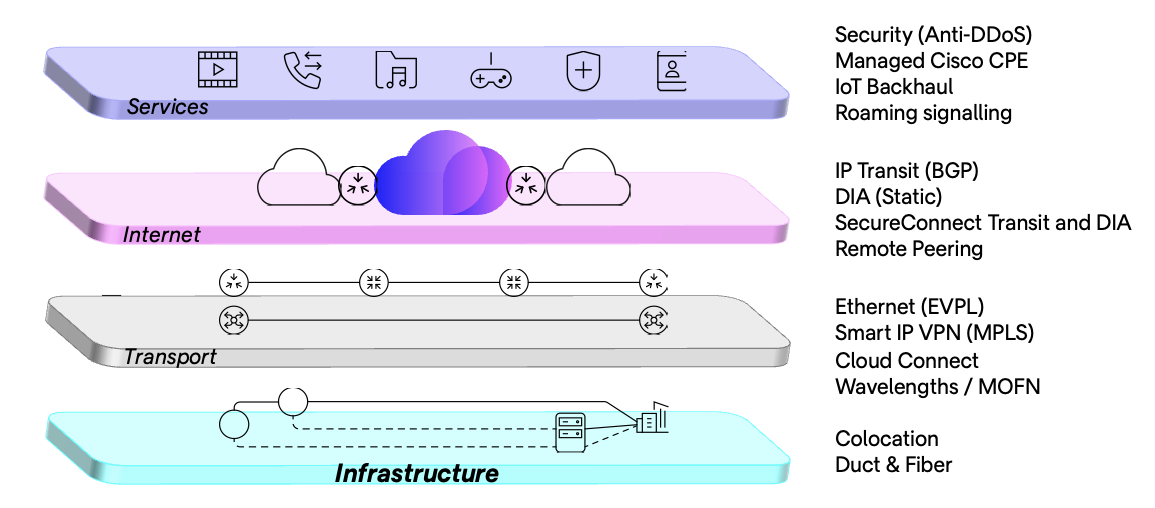
Arelion product portfolio-adapted OSI model
Physical network infrastructure starts underground and often undersea. Data travels through fiber optic cables pulled through ducts, spliced and joined in manholes, amplified over long distances, and repeated across subsea cables connecting continents. Every element matters.
Ducts are the protective pathways that host fiber cables. When designed correctly, multiple ducts are installed along the same route to allow future growth, physical diversity, and additional fiber pairs without new civil works. This enables both rapid scaling and long-term investment protection. Right of way access to these routes is a critical and scarce asset, especially across borders and within dense metropolitan areas.
Inside the ducts, fiber infrastructure carries light signals across vast distances. Terrestrial fiber cables may contain hundreds of fiber pairs, while subsea cables are engineered to withstand extreme pressure and operate reliably for decades. Whether deployed as lit services or leased as dark fiber, fiber is the medium that enables modern digital life. In international fiber infrastructure, reliability and route diversity are especially crucial, as outages can impact entire regions.
Splicing points and manholes allow fiber cables to be joined, branched, or repaired. These are essential components of a resilient network design, enabling maintenance and fault isolation without disrupting service over large areas. Physical diversity at this level is what protects networks against cable cuts and other physical incidents.
Over long distances, optical signals weaken and must be amplified to maintain quality and reach. This is where in-line amplification (ILA) plays a central role. Amplifier sites are placed strategically along fiber routes, typically every 80 to 120 kilometers, ensuring signal integrity across metro, regional, and international spans.
Within these sites, EDFAs (Erbium Doped Fiber Amplifiers) and Raman amplifiers are used to boost optical signals without converting them back to electrical form. EDFAs are widely used in modern optical networks due to their reliability and efficiency, while Raman amplifiers provide more powerful and flexible gain characteristics for longer distances or higher capacity systems.
These amplifier locations are not just technical necessities; they are strategic assets. They enable high capacity wavelength services, dense DWDM systems, and long-haul connectivity that support cloud platforms, internet backbones, and AI driven workloads. For fiber carrier providers, ownership and control of amplifier sites is a key differentiator.
| Infrastructure components | Description |
|---|---|
| Ducts | Ducts are the protective conduits that house fiber cables (typically measuring 32/40 mm in diameter) with larger dimensions if used in dense urban environments to accommodate higher capacity and future expansion. They are designed to enable efficient cable installation, protection against environmental factors, and scalable network growth through additional fiber deployment over time. |
| Fiber cables for terrestrial use | Designed to provide high-capacity data transmission over long distances, with configurations typically supporting up to 432 fibers for backbone deployments. These high-fiber-count cables enable scalable network expansion, efficient utilization of duct space, and the ability to support multiple services and customers on a single physical route. |
| Fiber cables for underwater use | Engineered to withstand harsh marine environments and high pressure, with unrepeated cables typically supporting up to 144-192 fibers for shorter subsea spans. For long-haul, repeated transoceanic systems, fiber counts are lower (typically 24-48 fibers) to accommodate optical repeaters and ensure optimal signal performance over ultra-long distances. |
| Amplifier sites | Amplifier sites, also known as in-line amplifiers (ILAs), are deployed along fiber routes to boost optical signals and extend transmission distances without converting them to electrical signals. Typically placed at regular intervals on long-haul terrestrial and subsea routes, ILAs play a critical role in maintaining signal integrity. |
|
Underwater repeater |
Underwater repeaters are active devices installed along transoceanic fiber cables to regenerate and amplify optical signals over ultra-long distances. Placed at regular intervals on the seabed, they enable high-capacity transmission across oceans by maintaining signal strength and quality over thousands of kilometers. |
| Manhole for cable joints | Manholes for cable joints are underground access points where fiber cables are spliced, connected, or branched along a network route. |
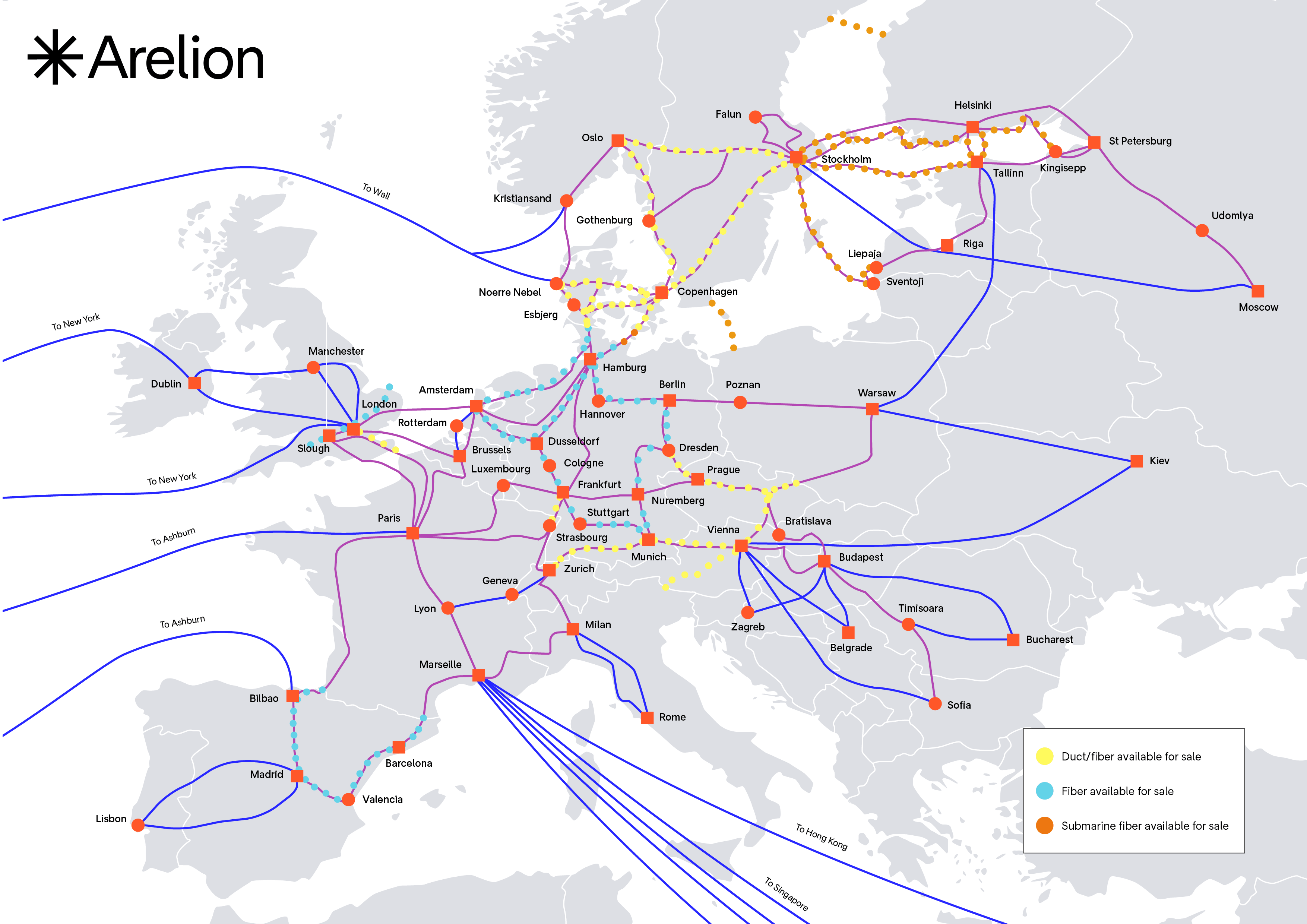
Arelion is one of the world’s leading fiber carrier providers, operating and continuously evolving an extensive international fiber infrastructure portfolio. Much of Arelion’s owned network in Europe was constructed in the early 2000s with long-term foresight. When building ducts, multiple parallel ducts were installed, often far more than initially required. Today, this design decision provides empty ducts and available capacity exactly when demand for fiber, Wavelengths, and AI data center connectivity is accelerating.
(...)A hallmark of Arelion’s infrastructure is the Scandinavian Ring, a high resilience fiber network connecting key markets across Sweden, Norway, and Denmark. Built with multiple ducts and high quality G.652.D fiber, this ring integrates directly with major data centers and cloud locations, while remaining expandable through overpull and fiber upgrades driven by customer demand.
Arelion’s network is further strengthened by long-term leased fiber and selective new construction, ensuring optimal routes, geographic diversity, and access to strategic cable landings. This includes diverse paths toward major subsea cable landing points, enabling resilient connectivity to North America and continental Europe.
Along these routes, Arelion operates purpose built amplifier sites at intervals of approximately 100 kilometers, within the typical 80 to 120 kilometer range. These facilities provide the space, power, and environmental stability required for DWDM and Wavelength infrastructure, while also enabling colocation opportunities for customers deploying their own optical equipment. Power redundancy, batteries, and generators ensure continuous operation even under adverse conditions.
The importance of physical network infrastructure is growing rapidly with the rise of AI data centers and workloads involving multiple GPU systems. Unlike traditional enterprise traffic flows, AI environments generate massive east west traffic between GPUs, synchronized at microsecond scale. This places unprecedented demands on fiber infrastructure, amplification quality, latency control, and network scalability.
As organizations deploy AI factories closer to power sources and distribute workloads across campuses and regions, demand increases for dark fiber, high count fiber pairs, Wavelength services, and long-haul connectivity between data centers. Subsea cables and international fiber infrastructure remain critical, as more than 95% of intercontinental data traffic continues to traverse undersea routes.
Arelion’s physical foundation, ducts, fiber, amplifiers, buildings, and right of way, positions the company to support this next generation of connectivity. The same infrastructure that powers today’s internet and cloud services is being evolved to support future requirements such as 800G and 1.6T optical systems, GPU centric architectures, and globally distributed AI platforms.
Arelion delivers end to end connectivity across every network layer, from physical infrastructure to advanced IP and security services. For customers, this means far more than breadth of portfolio, it means simplicity, performance, resilience, and control.
By owning, operating, and continuously evolving its physical network infrastructure, Arelion delivers more than connectivity, it delivers confidence. Customers benefit from a single provider that controls the entire underlay, from ducts and fiber pairs to Wavelengths, Ethernet, Internet services, and security capabilities such as large-scale DDoS mitigation.
This integrated approach ensures predictable performance, built in resilience, and future ready scalability. It removes dependency on fragmented supply chains and enables customers to build their digital platforms on a foundation designed for growth, reliability, and global reach.
In a world where applications, clouds, and AI systems evolve rapidly, the physical network infrastructure beneath them must be engineered to last. That is where Arelion’s experience, assets, and long-term vision make a decisive difference.
Arelion is a trusted, long-term infrastructure provider for resilient and high-performance long-haul and metro network projects.
Network infrastructure is the physical foundation that carries digital traffic: ducts, fiber optic cables, subsea cables, splicing points and manholes, and in-line amplification (ILA) sites. It is the passive, long-lived Layer 1 underlay on which transport, Internet and application services are built, and it supports everything from cloud computing and enterprise networks to 5G/6G and AI workloads.
Without a stable and well-designed Layer 1, no reliable network can be built on top of it. A solid physical layer also delivers physical diversity, which limits the impact of cable cuts and outages and increases availability, resilience and security across every layer above it.
Installing parallel ducts allows additional fiber pairs to be deployed later without new civil works. This provides future growth, physical diversity and long-term investment protection, particularly where right of way is scarce, such as across borders and in dense metropolitan areas.
Optical signals weaken over distance and must be amplified to maintain quality and reach. In-line amplifiers are placed along fiber routes, typically every 80 to 120 kilometers, to preserve signal integrity across metro, regional and international spans. Arelion operates purpose-built amplifier sites at intervals of approximately 100 kilometers.
Both boost optical signals without converting them back to electrical form. EDFAs (Erbium-Doped Fiber Amplifiers) are widely used in modern optical networks for their reliability and efficiency, while Raman amplifiers provide more powerful and flexible gain characteristics for longer distances or higher-capacity systems.
Dark fiber is fiber leased without active equipment, so the customer lights it with their own optical systems. It suits organizations that want full control over capacity, technology choices and upgrade cycles, while lit services such as Wavelengths, Ethernet or IP Transit are the better fit when the network should be delivered and operated as a managed service.
AI environments generate massive east-west traffic between multiple GPU systems, synchronized at microsecond scale. That drives demand for dark fiber, high-count fiber pairs, Wavelength services and long-haul connectivity between campuses and regions, and it raises the bar for amplification quality, latency control and scalability. Subsea cables remain critical, as more than 95% of intercontinental traffic travels undersea.
When one provider owns and operates the underlay as well as the services above it, from ducts and fiber pairs to Wavelengths, Ethernet, Internet services and DDoS mitigation, customers gain predictable performance, built-in resilience and future-ready scalability. It also removes dependency on fragmented supply chains and simplifies accountability for the entire connection.
 Search